


16
JulBuild a Complete Canadian Family Sponsorship Document File
An official-source document planning guide
Build a Complete Canadian Family Sponsorship Document File
Short answer: There is no single family sponsorship document list for every applicant. Start with the current IRCC application package for the exact relationship, class and country instructions. Build separate folders for sponsor forms, applicant forms, identity and civil-status records, relationship evidence, previous relationships, dependent children, financial or undertaking evidence where required, translations and submission records. Reconcile every name, date, address and family member across the complete file before submission.
Family sponsorship applications often become difficult because documents are collected as a pile instead of a connected evidence file. A marriage certificate, passport, address history and relationship form can each be accurate while still contradicting one another on spelling, dates or prior status.
This guide uses a document-control workflow rather than repeating a static form list. IRCC forms and instructions change, and the correct package depends on who is being sponsored, the application class, residence, country-specific instructions and case history. The article does not assess eligibility, create a lawyer-client relationship, predict processing time or promise an outcome.
Identify the sponsorship route before collecting documents
Write down who the sponsor is, who the principal applicant is, their relationship, where each person lives, the intended application class, whether dependent children are included and whether Quebec procedures may apply. A spouse, common-law partner, conjugal partner, dependent child, parent, grandparent or other relative does not necessarily use the same package.
IRCC’s current spouse, partner and child application page directs applicants to an application package containing the document checklist, required forms and country-specific instructions. Do not reuse a checklist saved for another relative or downloaded for an earlier filing without confirming it remains current.
If the route is uncertain because of residence, status, previous sponsorship, criminality, medical issues, adoption, guardianship, custody, a previous refusal or another material fact, obtain case-specific legal advice before choosing the package.
Freeze the current IRCC checklist for your file
Download the checklist and guide from the official IRCC page on the day the file is opened. Record the source URL, form number, visible version date and download date. If the online process generates personalized instructions, save those instructions with the file. Check again immediately before submission.
IRCC’s forms and guides index lists current documents, including relationship-specific checklists. The index is a discovery tool; the application package and checklist decide what belongs in the actual submission.
Create three status labels: required, conditional and not applicable. Never delete a conditional line simply because it is inconvenient. Add a short note identifying the fact that makes it applicable or not applicable, then have that judgment reviewed where it affects eligibility or completeness.
Build a source map before scanning
| Checklist requirement | Source document | Owner | Status and issue |
|---|---|---|---|
| Identity | Passport biographical page | Sponsor or applicant | Current, expired or renewal in progress |
| Civil status | Marriage, birth, divorce or death record | Relevant person | Name and date matched |
| Relationship evidence | Communication, visits, shared obligations or declarations | Both | Period and context identified |
| Family information | Official records and completed forms | Each adult | All family members reconciled |
| Country instruction | Police, civil or local record | Person named | Correct issuing authority |
The map should point to the authoritative source for each fact. A typed summary can explain evidence but cannot replace a required official record. Keep original-language documents, translations and certified copies linked by a matching file number.
Reconcile identity and civil-status records
Compare passports, birth certificates, national identity documents, marriage records, divorce documents, death records, adoption or custody documents and any name-change evidence required by the checklist. Record alternate spellings, transliterations and previous names. Do not silently standardize a discrepancy.
Create a one-page identity table for every person in the application: full name, date of birth, place of birth, citizenship, passport number and validity, marital status and relationship to the principal applicant. Use this as a quality-control sheet, not as a substitute for forms or evidence.
When a civil document is unavailable, follow the exact IRCC and country-specific instruction for alternatives or explanations. Do not invent a document, edit an official record or use a generic affidavit without confirming it is permitted and adequate for the situation.
Organize relationship evidence by question and period
Relationship evidence should help a reviewer understand the nature, development and continuity of the relationship without drowning the file in repetitive material. Begin with the checklist categories, then select representative records that answer them. Examples can include communication, visits, shared residence, financial responsibilities, public recognition, family involvement and plans, but the correct evidence depends on the relationship and application route.
Use a chronology with date, event, people involved and linked exhibit. Add short captions that explain context rather than emotional claims. If the relationship includes periods apart, language differences, a private ceremony, limited family participation or another fact that may require context, explain it truthfully and connect the explanation to records.
Do not manufacture messages, stage photographs, alter timestamps or omit a material inconsistency. IRCC’s current sponsorship guide warns that false or misleading information is a serious offence and that application information may be verified.
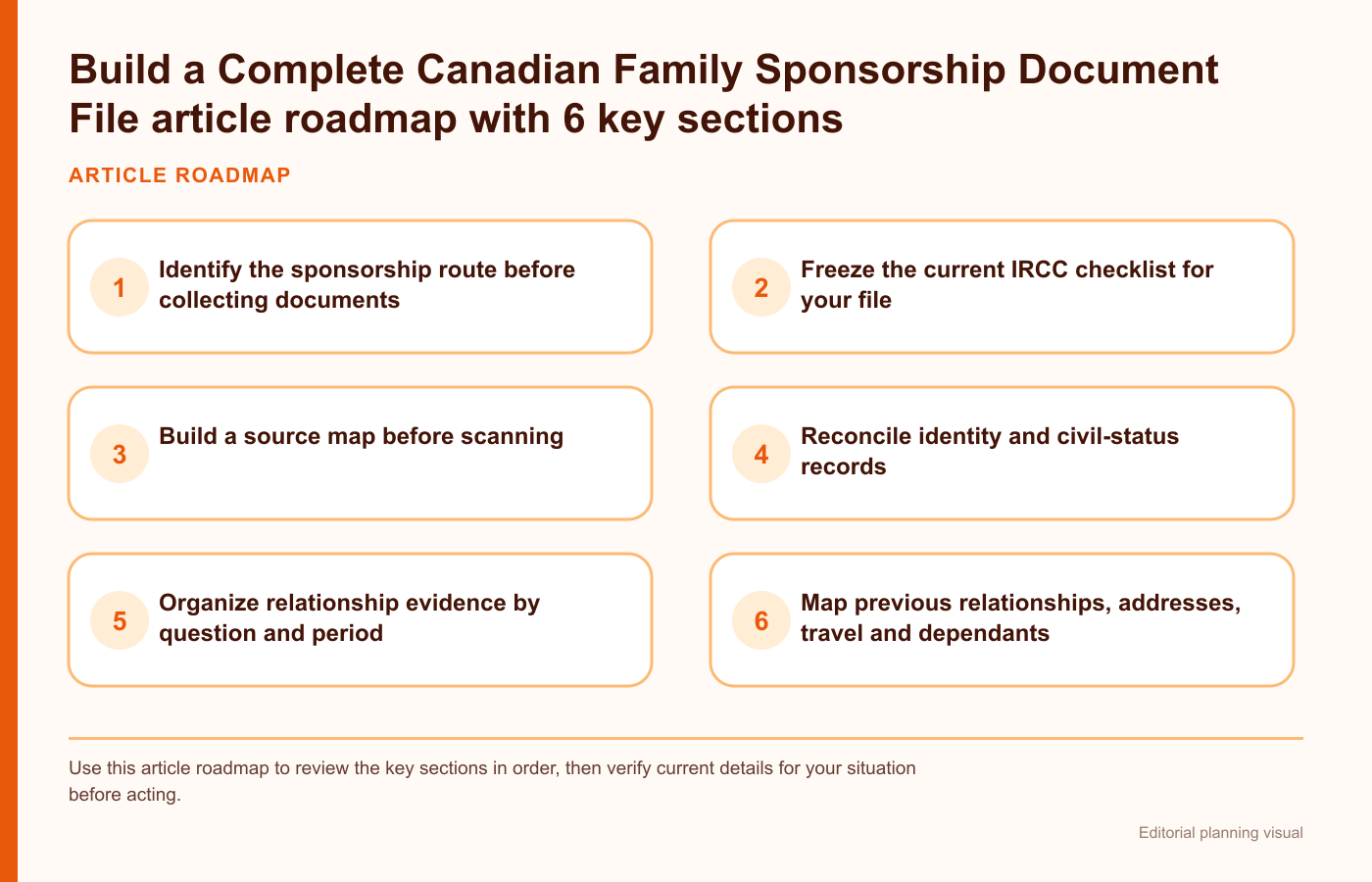
Map previous relationships, addresses, travel and dependants
Build a complete chronology before filling forms. Include address, personal history, employment or education, travel and immigration history for the periods requested by the current instructions. Reconcile gaps and overlaps. The application may require details for adult family members as well as the principal applicant.
List all family members exactly as the forms define them, including non-accompanying family members where required. Document custody, consent, adoption, prior marriages, divorces, deaths and children from previous relationships when applicable. A person being “not included” in travel plans does not necessarily mean the person can be omitted from required family information.
Legal advice is especially important where a family member was not declared in an earlier immigration process, a child’s other parent has rights, a record conflicts with current facts, or an admissibility concern exists.
Control translations, copies and document quality
IRCC’s current supporting-document language guidance says documents not in English or French generally require the translation, an affidavit from the translator and a certified photocopy of the original, unless IRCC says otherwise. Apply the instruction for the actual program and document; passport translation rules or another department’s standard may differ.
- Keep the original-language scan complete and legible.
- Use the translation method required by the current IRCC instruction.
- Link the translation, affidavit and certified copy to the same exhibit number.
- Do not let the applicant or a family member translate where the instruction prohibits it.
- Check names, stamps, seals, marginal notes and handwritten text.
- Preserve colour and resolution where a mark or security feature matters.
Do not crop edges, obscure reverse-side text or combine files so aggressively that a document becomes unreadable. Follow the current portal’s file type and size rules.
Run a four-pass consistency review
- Completeness pass. Match every checklist line to a file or a reviewed explanation.
- Identity pass. Compare names, birth dates, passport details and relationships across every form and record.
- Chronology pass. Check address, work, education, travel, relationship and immigration timelines for unexplained gaps or conflicts.
- Signature pass. Confirm the correct person completed, signed and dated each form using the current electronic or PDF process.
IRCC’s current spouse, partner and child application materials distinguish forms completed by the sponsor from digital forms completed by the principal applicant. Follow the live package rather than an old screenshot. Confirm whether dependants or adult family members have their own signature or form requirements.
Make corrections transparently. If an answer changed after a document was issued, explain the sequence and support it. A neat file is not a substitute for accurate disclosure.
Prepare a submission record and change log
Before upload, create a final index with the portal field, filename, document description, person, date range and version. Use stable filenames without ambiguous labels such as “final2.” Open every uploaded file from the submission folder and verify orientation, pages, readability and correct placement.
Save a complete copy of the forms, supporting documents, fee receipt, confirmation page and messages submitted. Record the submission date and account used. After filing, track new passports, changes in family composition, address or contact changes, requests from IRCC and response deadlines. Obtain advice about what must be reported and how.
Do not email sensitive records to an unverified address or upload them to an unofficial portal. Confirm that a representative is authorized and that the retainer clearly defines the work, fees, communication and responsibility for final review.
Use this final document-control table
| Gate | Ready when | Stop when |
|---|---|---|
| Correct route | Relationship, class and residence match the live package | The package was copied from another application |
| Checklist | Version and country instructions are recorded | A conditional item is unresolved |
| Evidence | Each claim connects to a reliable source | Material facts rely only on a summary |
| Consistency | Names, dates and histories reconcile | A discrepancy is silently edited |
| Submission | Every uploaded file was reopened and checked | Pages are unreadable or in the wrong field |
Family sponsorship document mistakes to avoid
- Using a static internet checklist. Start from the current IRCC package.
- Collecting documents before choosing the route. Requirements vary.
- Ignoring country-specific instructions. Local civil and police records can have special rules.
- Overloading relationship evidence. Select representative, explained records.
- Leaving timeline gaps. Build the chronology before form entry.
- Using the wrong translation standard. Follow the program-specific IRCC instruction.
- Submitting without a complete copy. Preserve exactly what was filed.
Frequently asked questions
Is there one checklist for all family sponsorship applications?
No. The package depends on the relationship and application route, and country-specific instructions can add requirements. Use IRCC’s current application page and checklist for the case.
Should I submit every photo and message from the relationship?
Not necessarily. Follow the checklist, portal limits and applicable legal advice. Select representative evidence that answers the requirement and explain its date and context.
Can a family member translate my documents?
Do not assume so. IRCC’s general supporting-document guidance requires a translation package and sets translator requirements. Confirm the current instruction for the application and document.
Request a case-specific document review
Start with IRCC’s live package, then review Rathod Law Firm’s family immigration service page and team page. Use the firm’s current contact route to ask what a consultation covers, who will perform the work, what fees apply and how credentials can be verified. Ontario consumers can independently check a legal professional’s current status in the Law Society directory.
General information only, not legal advice and not an IRCC checklist. Immigration law, forms, procedures and facts change. No lawyer-client relationship or outcome is created by reading this page.