


14
JulHow to Evaluate a Free Family Law Consultation in Ontario
Ontario family lawyer consultation guide
How to Evaluate a Free Family Law Consultation in Ontario
Short answer: A free family law consultation should be evaluated by scope, not by the word free. Confirm how the meeting was obtained, its length, who will attend, whether advice or document review is included, what conflict check is needed, and what fees apply afterward. Rathod Law Firm publishes a consultation route, but a free family-law consultation from that firm has not been verified.
Someone facing separation, parenting, support or property questions may need direction quickly, yet an introductory call can pass before the most important facts are clear. A focused consultation is not a full case plan. Its job may be to identify the issue, hear the time-sensitive facts, explain possible next steps and decide whether lawyer and client are a fit. This guide helps Ontario readers prepare, compare lawyers and avoid assuming that every consultation has the same cost or scope.
Confirm why the consultation is free
A law firm may offer an introductory call under its own policy, participate in a referral program, hold a limited clinic, or use a short call to decide whether it can take a matter. Those are different arrangements. Ask who provides the meeting, how long it lasts, whether it is by telephone, video or in person, and what can be covered without charge.
The Law Society of Ontario’s Law Society Referral Service says an eligible referral may include a free consultation of up to 30 minutes, if a match is available and the professional has capacity. The service also explains that legal work and second opinions are not included. That LSRS policy does not mean every Ontario lawyer or every direct booking must be free.
Rathod Law Firm’s live site contains “consultation” and scheduling calls to action, but the reviewed pages do not verify a no-cost family-law meeting, its duration or its scope. Ask the firm directly before booking and keep the written answer.
Identify the legal issue and the urgent date
Family law can involve separation, divorce, parenting time, decision-making responsibility, child support, spousal support, property, safety, enforcement or changes to an existing agreement or order. The same facts can affect more than one issue. Begin the call by naming the immediate problem and the decision you need to make, not by trying to recount the entire relationship minute by minute.
Write down every known court date, response deadline, scheduled move, travel date, closing date, benefit change or safety concern. Tell the lawyer about urgency at the start. If there is immediate danger, a child-safety emergency or another crisis, use the appropriate emergency or crisis service rather than waiting for a routine consultation.
Ontario’s family law services page outlines the broad topics and family-court context. It is public legal information, not advice about a particular case. Use it to label your issue and then ask a lawyer how Ontario law and procedure apply to your facts.
Prepare a one-page fact summary
A concise chronology leaves more time for useful questions. List the relationship dates, children’s ages, current parenting arrangement, living situation, employment or income changes, major assets and debts, existing agreements or orders, prior court activity and the recent event that created the need for advice. Mark what is known, what is disputed and what document supports each important point.
Do not send sensitive records until the office tells you how to transfer them securely and completes any preliminary checks. Ask which documents can actually be reviewed during the introductory meeting. A short consultation may not include reading a long message history, financial disclosure package or draft agreement.
- Government-issued identification if requested.
- Existing court orders, agreements and filed documents.
- Notices showing a hearing or response date.
- A short income, asset and debt outline when financially relevant.
- A one-page chronology and a list of your top three questions.
- Names needed for a conflict check.
Check experience, role and lawyer fit
Ask who will conduct the consultation and who would do the work if the matter proceeds. Confirm that the professional practises in the relevant area and Ontario forum. Family law advice and representation must be distinguished from administrative intake or services outside a professional’s authorized scope.
Review the lawyer’s name in the Law Society directory and check practising status. Ask about experience with the type of issue and level of conflict involved, but do not expect a past-result story to predict your outcome. The better signs are clear listening, careful limits, transparent next steps and willingness to identify missing information.
Rathod Law Firm publishes a team page and a family law services page. Use those pages to identify the proposed professional and service scope, then verify the current lawyer-client assignment during the consultation.
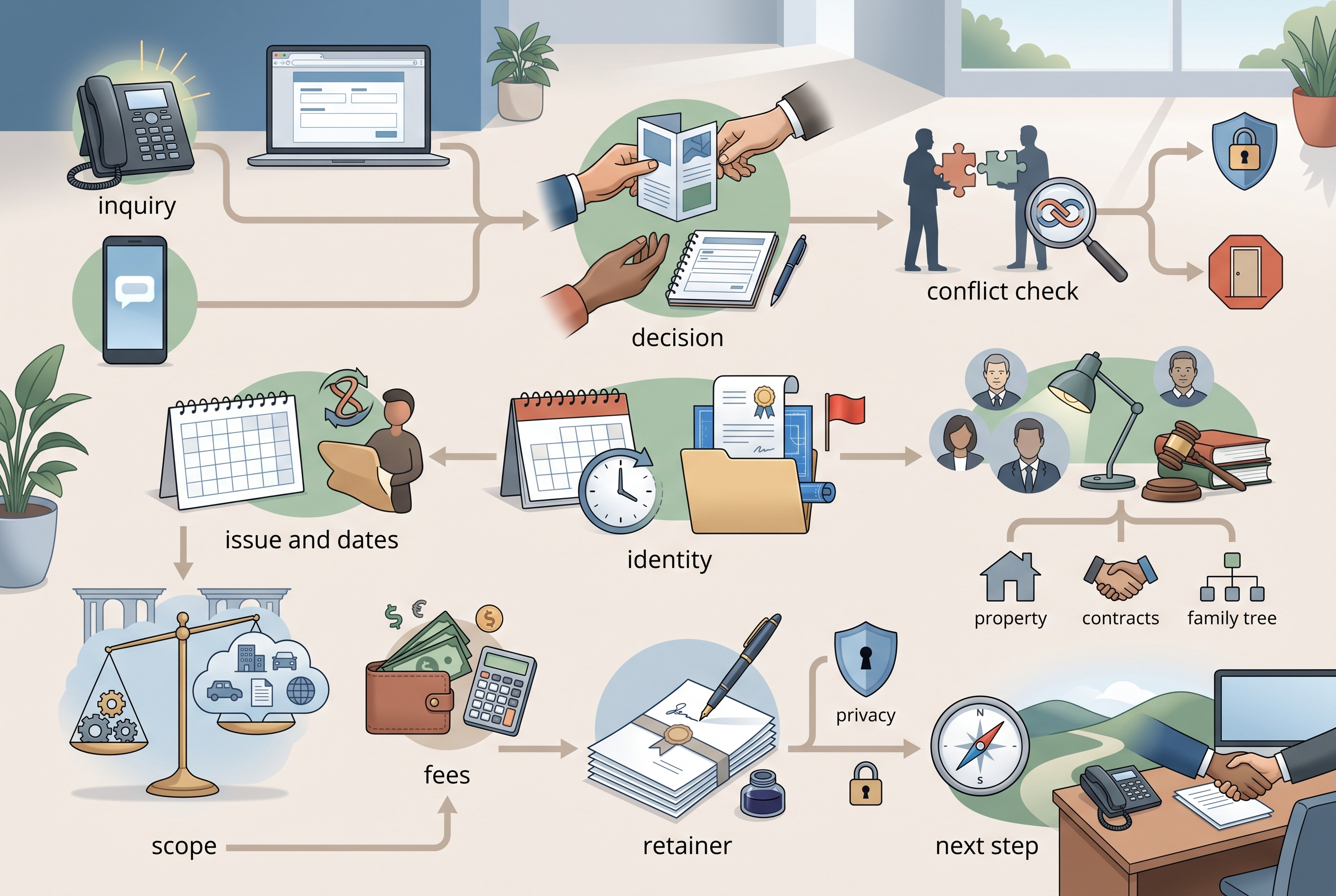
Understand conflicts and confidentiality before details
A firm may need the names of the other party and connected people before receiving detailed information. This helps it check whether acting would create a conflict. Provide accurate names, but follow the office’s direction about when and how to send sensitive material. A consultation request does not guarantee that the firm can accept the matter.
Ask when a lawyer-client relationship begins, what information the firm stores, and whether the introductory discussion is confidential. Do not assume that filling out a web form, speaking with intake staff or receiving general information means the lawyer has agreed to protect a deadline or act in court.
Clarify who may join the call. A friend or family member can affect privacy and may make it harder to discuss sensitive facts. Translation and accessibility should be arranged deliberately. Ask whether the office provides or permits an interpreter and how confidentiality will be handled.
Use the consultation to ask decision-ready questions
- What issues do you hear in this fact pattern?
- Which facts or documents could materially change the analysis?
- Is there a deadline or step I should address first?
- What dispute-resolution and court paths may be available?
- What should I avoid doing while I obtain advice?
- What additional information is needed before advice can be complete?
- Would you handle the matter, and who would work on it?
- What service scope and fee arrangement could apply?
- What will happen after this call if I want to proceed?
- What should I do if the firm cannot act?
The Ontario guide on getting legal advice in family court explains that a lawyer can address options, rights, responsibilities and consequences. It also notes options such as the Law Society Referral Service, Legal Aid Ontario and limited-scope services. Eligibility and fit still need individual confirmation.
Compare consultation scope and the paid next step
| Field | What to confirm | Why it matters |
|---|---|---|
| Source | Direct firm offer, LSRS referral or another program | The free scope may depend on the route |
| Time | Length, format and who attends | A short call needs a focused agenda |
| Scope | Information, advice, document review or intake | “Consultation” can describe different work |
| Conflict | Names, checks and information-transfer process | The firm may be unable to act |
| Representation | When a retainer begins and which tasks are included | An inquiry alone does not protect a deadline |
| Fees | Hourly, flat, limited-scope, retainer, tax and disbursements | The full service cost extends beyond the first meeting |
| Next step | Documents, payment, agreement and timing | Both sides need a clear handoff |
Ask for a written retainer or limited-scope agreement before paid work begins. Read which tasks are included, who communicates with the other party, who monitors dates, how funds are handled and how either side may end the relationship. If the arrangement does not match what you heard, ask before signing.
Leave the call with a documented next step
At the end, repeat the next action and who owns it. The next step may be sending a limited set of documents, booking a paid meeting, applying for a service, obtaining disclosure, preserving a deadline or seeking urgent help. Ask whether the lawyer is acting now or only after a retainer is signed and accepted.
Write down the advice in your own words and separate it from options that still depend on more facts. Do not forward legal communications casually or post the dispute online. Ask the lawyer how to preserve relevant messages and records without altering, deleting or improperly accessing information.
If the firm cannot help, request the appropriate referral route. The Law Society directory, LSRS, Legal Aid Ontario and Family Law Information Centres may be relevant depending on location, income, urgency and issue. None guarantees representation. Continue protecting known dates while searching for assistance.
Common mistakes to avoid
- Assuming every firm offers a free family-law consultation.
- Using most of a short call to give an unstructured relationship history.
- Hiding an urgent date until the end of the meeting.
- Sending sensitive documents before asking about conflicts and secure transfer.
- Expecting a complete opinion without core facts or documents.
- Treating an intake call as confirmation that the lawyer is acting.
- Choosing by a promised outcome instead of role, scope and communication.
- Signing a retainer without understanding fees, tasks and responsibility for deadlines.
Frequently asked questions
Does every Ontario family lawyer provide a free consultation?
No. LSRS has a defined referral consultation when its conditions are met, while direct law-firm policies vary. Confirm cost, length and scope with the specific office.
Will a free consultation include document review?
Not necessarily. A short meeting may focus on identifying issues and options. Ask which documents the lawyer will review and whether that work is included before sending files.
Does speaking to a lawyer mean they represent me?
Not automatically. Ask when the lawyer-client relationship starts and obtain the written agreement. Do not assume the lawyer is monitoring a deadline unless that responsibility has been accepted.
What if I cannot afford full representation?
Ask about Legal Aid Ontario, limited-scope services, Family Law Information Centres and other eligible resources. Availability, eligibility and suitability vary.
Confirm the consultation terms before sharing your case
Use Rathod Law Firm’s contact page to ask whether a family-law consultation is currently free, its length, who conducts it, what it includes and which conflict-check information is needed. Confirm fees and representation terms in writing before further work. This article provides general Ontario information, not legal advice, and does not create a lawyer-client relationship.
Sources and business details were reviewed for this local editorial package. Time-sensitive terms, professional status, service availability and individual suitability must be confirmed before publication or action.