


25
MarHow to Appeal an Immigration Decision in Canada: Win Your Case in 2026
You received a refusal or removal order and you’re asking how to appeal immigration decision Canada without losing time or options. Here’s the thing—appeals and judicial reviews move on strict clocks. One missed step can derail a strong case. This practical guide, written from a Brampton practitioner’s perspective, shows you exactly where to file, what to submit, and how to avoid common mistakes in 2026.
At a Glance
- Know your forum: Immigration Appeal Division (IAD), Refugee Appeal Division (RAD), or Federal Court judicial review.
- Track deadlines: as short as 15 days in some cases—timing decides outcomes.
- Build a record that persuades: objective evidence, credible testimony, and organized filings.
- Use stays, ADR, and tailored arguments to protect status while your case proceeds.
- Get coordinated support: Rathod Law Firm’s lawyer–paralegal team manages filings, evidence, and hearings from our Brampton office.
Quick Answer
To appeal an immigration decision in Canada, pick the correct path (IAD, RAD, or Federal Court), file within the deadline, and submit focused, credible evidence. If you’re near Ontario at 106-2250 Bovaird Drive East, Rathod Law Firm can prepare your appeal strategy, paperwork, and hearing representation.
Local Tips
- Tip 1: Driving via Highway 410 to Bovaird Drive East? Leave buffer time for weekday congestion and bring your original decision letter and ID to the consultation.
- Tip 2: Winter weather in Peel can delay couriers. For tight RAD or Federal Court timelines, use tracked delivery or verified e-filing and save confirmations.
- Tip 3: For downtown Toronto hearings, arrive early for security. We run a mock hearing so you’re confident with procedures and testimony.
IMPORTANT: These are real logistics we plan around for clients in Brampton and the GTA.
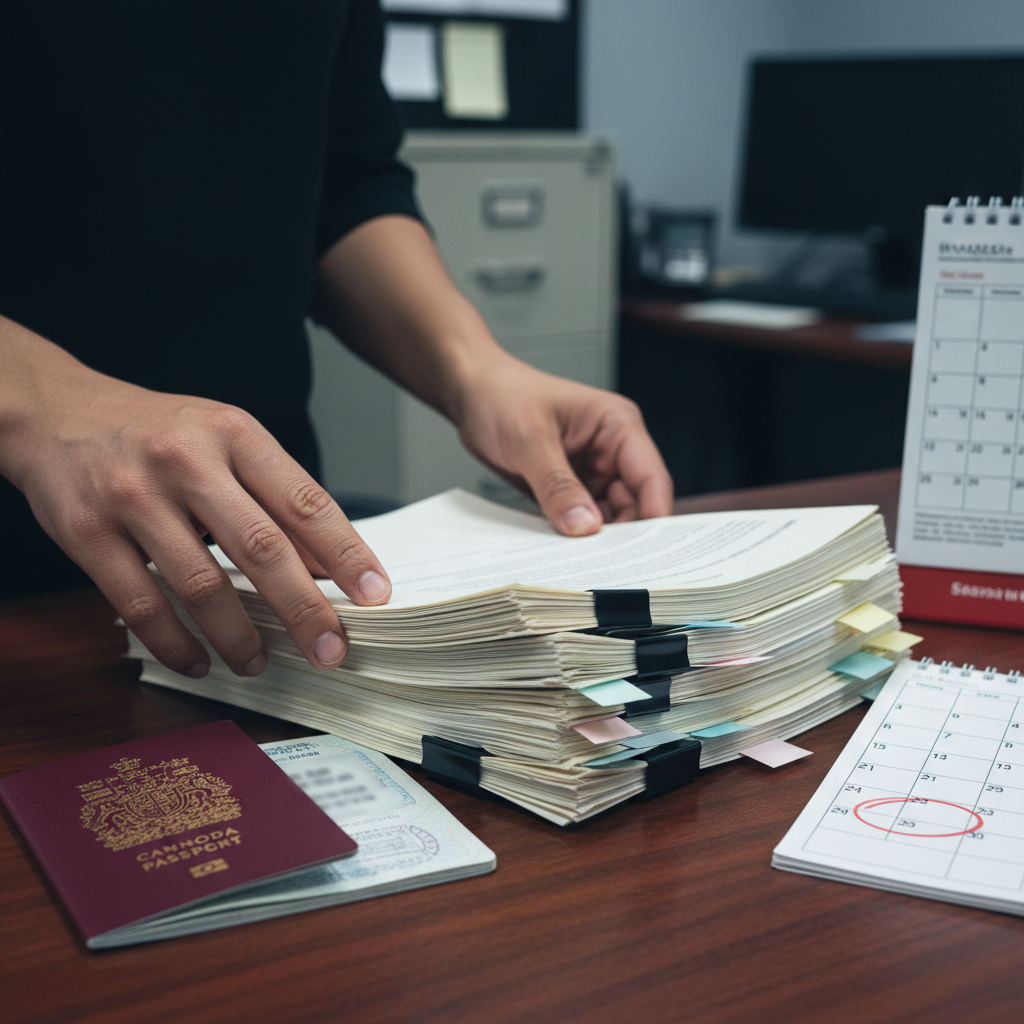
Before You Start (Prerequisites)
Clarity at the start prevents lost time and missed rights. Here’s what to confirm before you act.
- Identify the right forum
- IAD: Sponsorship refusals, certain removal orders (for permanent residents and protected persons), residency obligation determinations.
- RAD: Appeals from the Refugee Protection Division (limited exceptions apply).
- Federal Court: Judicial review where no tribunal appeal exists (e.g., study/work permits, PR refusals under economic classes, TRVs).
- Confirm deadlines (2026)
- IAD: Often 30 days from the date you receive the decision to file a Notice of Appeal.
- RAD: Typically 15 days to file the Notice and 30 days to perfect, counting from receipt of written reasons (watch delivery rules).
- Federal Court: Generally 15 days if you’re in Canada (60 days if outside Canada) to file the application for leave and judicial review; perfection follows set timelines.
- Gather the core record
- Decision letter and full reasons (including any GCMS notes if relevant).
- Original application package and prior correspondence.
- Proof of receipt dates (email headers, courier tracking, stamped mail).
- Identity/status documents, and objective support (employment, medical, school, tenancy, community ties).
- Understand service/e-filing rules
- File naming, page limits, affidavit/statutory declaration formats, confirming service on the Minister, and keeping delivery receipts.
- Engage counsel early
- Rathod Law Firm’s integrated lawyer–paralegal team builds the appeal record, coordinates witnesses, and manages deadlines from our Brampton office, Monday to Friday, 9:00 AM–5:00 PM.
How to Appeal Immigration Decision Canada: Step-by-Step
Use this sequence to protect timelines and present the strongest case possible.
Step 1 — Map your decision to the correct forum
- What to map
- Sponsorship refusal or removal order → usually IAD jurisdiction.
- Refugee claim refused by RPD → RAD appeal (confirm exceptions like manifestly unfounded decisions).
- Temporary resident, work/study permit, or economic PR refusal → often Federal Court judicial review.
- Why it matters
- Choosing the wrong forum can forfeit your rights and burn precious time.
- Action
- Check the decision’s “right of appeal” section and relevant legislation/regulations. If unclear, get a same-day consult.
Step 2 — Lock the deadline and file your notice
- Build a deadline calendar
- Calculate from the legally recognized “date of receipt” (email vs mail rules differ).
- Buffer for weekends, holidays, and winter storms in Peel Region.
- Prepare a compliant notice
- Use the correct tribunal/court form, verify identity fields, and export clean, searchable PDFs.
- File and serve the Minister’s counsel properly; retain confirmations.
- Practical example
- A Brampton sponsor brings a spousal refusal. We file the IAD Notice within 30 days, then organize ADR-ready disclosure within weeks.
Step 3 — Seek a stay if removal is imminent
- When to request
- IAD removal order appeals can engage a stay in defined scenarios.
- For Federal Court, bring an urgent stay motion if CBSA removal is scheduled.
- Evidence that helps
- Hardship, best interests of any affected children, community integration, rehabilitation (if applicable), and realistic prospects of success.
- Field note
- We prep detailed affidavits and gather objective documents fast—school records, medical letters, and community support can be decisive.
Step 4 — Build a persuasive appeal record
- Documents to include
- Affidavits/statutory declarations, expert reports (where needed), background/country evidence (for RAD), and up-to-date clearances if relevant.
- Objective corroboration: employment letters, pay stubs, leases, utility bills, bank records, school/medical letters.
- Witness preparation
- Identify spouses, employers, teachers, religious/community leaders.
- Run mock direct and cross-examination to tighten timelines and facts.
- Organization matters
- Bates-stamp, paginate, and index exhibits exactly how the tribunal expects. Clarity improves credibility.
Step 5 — Perfect the appeal
- IAD
- Comply with disclosure timelines, file written submissions when required, and consider ADR (Alternative Dispute Resolution) if offered.
- RAD
- File the appellant’s record within 30 days: memorandum of argument, case law, and any new evidence allowed by the statute.
- Federal Court
- Submit application record, affidavits, and written argument addressing standard of review, legal error, and procedural fairness.
- Real example
- In a Toronto-area RAD matter, we focused on inconsistent credibility findings using objective corroboration and narrow, statute-compliant new evidence.
Step 6 — Hearing or decision
- IAD
- Member evaluates credibility, humanitarian and compassionate (H&C) factors, and the public interest.
- RAD
- Often decided on the record; oral hearings occur in limited scenarios.
- Federal Court
- If leave is granted, oral hearing centers on legal or procedural error. No new evidence is heard.
Step 7 — Post-decision strategy
- If allowed
- Implement the result quickly—schedule new interviews, update biometrics/medicals, or follow directions for reconsideration by the decision-maker.
- If dismissed
- Assess re-application, reconsideration, or further review options based on reasons and eligibility.
- Client scenario
- A Brampton family sponsorship refusal is set aside after ADR; we coordinate next steps with IRCC and track milestones until visa issuance steps resume.
Which Path Fits? (Comparison Table)
| Path | Typical Use | Deadline (File) | New Evidence? | Outcome Type |
|---|---|---|---|---|
| IAD | Spousal sponsorship refusals; certain removal orders; residency obligations | Often 30 days | Yes, including H&C factors | Allow/dismiss or remit |
| RAD | Appeals from RPD refugee refusals | 15 days to file; 30 to perfect | Limited by statute | Confirm/set aside/substitute |
| Federal Court | Judicial review where no appeal exists (e.g., permits, TRVs, many PR refusals) | 15 days in Canada; 60 days outside | No (record-based) | Grant/deny leave; if heard, quash/remit |

Need tailored help? Our team at Rathod Law Firm prepares IAD and RAD records, drafts Federal Court leave applications, and handles stay motions for clients across Brampton, Toronto, and Ontario.
Troubleshooting: Common Pitfalls (and Fixes)
These issues appear often—and they’re avoidable with the right process.
- Missed deadline
- Act immediately. Some forums allow extensions in narrow circumstances, but never rely on discretion. File what you can, then perfect.
- Wrong forum
- Withdraw and re-file if still within time. If not, seek advice on extraordinary remedies.
- Unorganized record
- Paginate, index, and label exhibits. Clear chronology reduces credibility concerns.
- Weak or inconsistent evidence
- Close gaps with objective proof: employment, tenancy, banking, photos with metadata, medical/school letters.
- No stay request when removal looms
- Coordinate an urgent stay where allowed. Bring detailed hardship and child best-interest evidence.
- Writing arguments like a fresh application
- RAD and Federal Court are record-focused. Anchor submissions in the standard of review and legal error, not just sympathetic facts.
Advanced Tips (2026)
- Use IAD ADR strategically
- When offered, ADR can resolve sponsorship disputes faster than a full hearing. Prepare core issues, credibility anchors, and corroboration.
- Know RAD limits on new evidence
- Only certain new evidence is admissible—targeted, reliable, and unavailable earlier despite diligence.
- Shape Federal Court arguments for legal error
- Emphasize procedural fairness, reasonableness, and decisive misapprehensions of evidence. Don’t re-try facts.
- Document authenticity and timelines
- For credibility-heavy files, include third-party verifications and a consistent chronology. Contradictions sink cases.
- Local coordination pays off
- For Brampton and Toronto hearings, we coordinate travel, interpreter bookings, and witness availability to avoid last-minute adjournments.
Mini Case Insights (Brampton & GTA)
- Spousal sponsorship refusal (IAD)
- Issue: genuineness concerns due to limited cohabitation.
- Approach: curated photos with metadata, joint finances, and affidavits from community leaders; ADR engagement.
- Outcome: allowed on H&C grounds; next steps implemented promptly.
- Refugee appeal (RAD)
- Issue: adverse credibility from minor date inconsistencies.
- Approach: objective country documentation and hospital records; targeted memorandum on misapprehension of evidence.
- Outcome: decision set aside and matter remitted.
- Study permit refusal (Federal Court)
- Issue: unreasonable assessment of home ties and program relevance.
- Approach: leave granted; argued unreasonableness and failure to consider key documents in the record.
- Outcome: decision quashed and remitted for redetermination.
Tools, Templates, and Checklists
- Appeal timeline tracker to map file, disclosure, and perfection dates.
- Evidence index template with exhibit numbers, dates, and short descriptions.
- Witness prep script covering direct, cross, and common credibility traps.
- Stay motion checklist for urgent removal cases (affidavits, exhibits, draft order, service proof).
Looking for broader background while you plan your appeal? See general immigration context from a third-party perspective, like this immigration law overview and a PR process explainer to understand how decisions flow into appeals.
FAQs
- How quickly should I act after a refusal?
Right away. Some appeal or judicial review deadlines are 15 days. File your notice first to stop the clock; then perfect your record with evidence and submissions. - Can I file new evidence on appeal?
IAD permits broad H&C material. RAD allows new evidence only within strict statutory criteria. Federal Court is record-based—no new evidence, focus on legal/fairness errors. - Do I need a lawyer and paralegal team?
Appeals are technical and deadline-driven. Our integrated team improves organization, argument quality, and compliance—key factors for credibility with decision-makers. - What if removal is scheduled?
Discuss an urgent stay immediately. Provide hardship evidence, child best-interest details, and proof of community ties to support the motion. - Is re-applying better than appealing?
It depends on your facts, timing, and the decision’s weaknesses. We often assess both paths—appeal/judicial review for legal error, or a fortified new application.
Additional Resources
- Official tribunal and court guides for filing formats, service, and deadlines.
- Country condition sources for RAD evidence planning.
- Affidavit/statutory declaration guidance for witness statements.
- Interpreter booking best practices for Brampton and Toronto hearings.
Key Takeaways
- Match your case to IAD, RAD, or Federal Court before the clock starts running.
- File the notice on time; perfect your record with organized, objective evidence.
- Use stays and ADR strategically to protect status and resolve faster.
- Build arguments around standards of review and statutory evidence rules.
- Local preparation (Brampton/Toronto) minimizes logistics risk on hearing day.
Next Steps
- Book a consultation at our Brampton office to map your deadlines and forum.
- Bring the decision letter, prior submissions, and identity/status documents.
- We’ll prepare a filing calendar, evidence plan, and mock-hearing schedule.
Soft CTA: Based in or near Ontario at 106-2250 Bovaird Drive East? Meet Rathod Law Firm to structure your IAD, RAD, or Federal Court pathway and move forward with confidence.
Conclusion
- Appealing an immigration decision in Canada starts with choosing the right forum and filing on time.
- Strong appeals use organized records, credible witnesses, and targeted legal arguments.
- Our Brampton-based lawyer–paralegal team supports appeals, refugee appeals, judicial reviews, and sponsorships across Ontario—preparing you for each milestone.
- Ready to take action? Book your session and bring your decision letter so we can get your calendar and evidence plan in motion.