


29
MaySpousal Sponsorship: Bring Your Partner Home in 2026
Spousal sponsorship is Canada’s family reunification program that lets citizens and permanent residents sponsor a spouse, common-law, or conjugal partner for permanent residence. From our office at 2250 Bovaird Dr E #106 in Brampton, Ontario, Rathod Law Firm helps couples verify eligibility, prepare evidence, and navigate appeals so families can live together lawfully.
By Kapil Rathod, Lawyer — Rathod Law Firm | Last updated: June 5, 2026
At a Glance
Spousal sponsorship reunites partners by granting permanent residence when a genuine relationship and eligibility are proven. You’ll choose inland or outland processing, submit forms and evidence, complete biometrics and medicals, and monitor decisions. If refused, you may appeal to the IAD or seek Federal Court review with legal advice.
This overview highlights what you’ll learn and how to use it quickly.
- What spousal sponsorship is and who qualifies
- Inland versus outland applications—and which fits your situation
- Documents that prove a genuine relationship and clean admissibility
- Step-by-step process, timelines, and status checkpoints
- Open work permits for spouses and when they apply
- Appeal options after refusal (IAD) and judicial review strategy
Local considerations for Ontario
- If you live near Professor's Lake Park or commute past Brampton Civic Hospital – Zum Bovaird Stop WB, bring clear address records (leases, bills) to support residence history.
- Winter mail delays are real. Build buffer time for police certificates and courier deliveries during peak weather and holidays.
- For in-person notarization of affidavits and statutory declarations, our Brampton office streamlines same-day appointments when available.
What Is Spousal Sponsorship?
Spousal sponsorship is a Canadian immigration pathway in which a citizen or permanent resident sponsors a spouse, common-law, or conjugal partner for permanent residence. Approval depends on a genuine relationship, sponsor eligibility, admissibility checks, and complete documentation filed through IRCC’s designated portals.
In plain terms, it’s how partners reunite in Canada. The program covers three partner types—spouse (legally married), common-law (12 months of cohabitation), and conjugal partner (commitment despite barriers to cohabitation or marriage). The sponsor must be at least 18, not barred by previous undertakings, and able to meet basic obligations.
- Relationship categories: spouse, common-law, conjugal partner
- Key checks: genuineness, sponsor eligibility, biometrics, medical, police certificates
- Outcome: permanent residence with a sponsor undertaking (3 years)
- Processing: via IRCC online systems, with status updates and biometrics collection
At Rathod Law Firm, we guide couples from first eligibility screening to final decision, and, where needed, through Immigration Appeal Division (IAD) hearings or Federal Court judicial review.
Why Spousal Sponsorship Matters
Spousal sponsorship keeps families together by granting lawful status and stability. For couples in Ontario’s Regional Municipality of Peel, it means work, study, and healthcare access for the sponsored partner and fewer travel separations during life events while their application is processed.
Family unity isn’t abstract—it affects housing, employment, schooling, and wellness. A well-prepared file reduces stress, shortens back-and-forth with immigration officers, and lowers the chance of procedural setbacks. When issues arise, a prompt strategy—whether supplementary evidence, interview prep, or appeal—is critical.
- Stability: lawful presence supports employment, schooling, and health coverage routines.
- Continuity: fewer cross-border trips and disruptions during processing.
- Predictability: organized submissions lead to clearer timelines and fewer document requests.
We’ve seen orderly files with strong relationship narratives receive fewer follow-ups, whereas sparse submissions invite clarification letters and interviews. A deliberate approach pays dividends.
How Spousal Sponsorship Works (Step-by-Step)
The process starts with eligibility checks and choosing inland or outland processing. Then you gather relationship evidence, complete forms, pay fees, submit online, give biometrics, complete a medical exam, and await a decision. If refused, you may appeal or seek judicial review with counsel.
Here’s the practical flow we walk clients through at our Brampton office.
- Eligibility screening: confirm sponsor age (18+), status, and undertakings; verify relationship category and admissibility risks.
- Strategy selection: choose inland (applicant in Canada) or outland (applicant outside Canada) based on travel plans, risk, and timing.
- Evidence plan: outline documents that prove genuineness (see checklist below).
- Forms and portal: complete IRCC forms precisely; use correct online portal for family sponsorship.
- Submit and track: file application, get AOR (acknowledgment of receipt), and track biometrics and medical requests.
- Requests and interviews: respond to document requests; prepare for interview if invited.
- Decision: approval leads to PR issuance steps; refusal triggers appeal or review options.
Open work permit pathways exist for inland applicants, enabling the sponsored spouse to work while processing continues. Biometrics typically remain valid for 10 years, and medical exams are generally valid for 12 months. Police certificates usually cover any country where you spent 6+ months since age 18.
Document checklist that actually works
- Identity and status: passports, birth certificates, status documents
- Relationship proof: marriage certificate, 12+ months cohabitation evidence for common-law, photos over time
- Joint life indicators: leases or mortgage, joint bank accounts, insurance beneficiaries, shared bills
- Communication history: call logs, travel itineraries, messages (sampled responsibly)
- Affidavits/statutory declarations: from friends/family; notarized where appropriate
- Admissibility: police certificates (6+ months rule), medical exam confirmation
We sequence evidence to tell a coherent story—milestones, living arrangements, finances, and future plans—rather than a disjointed document dump.
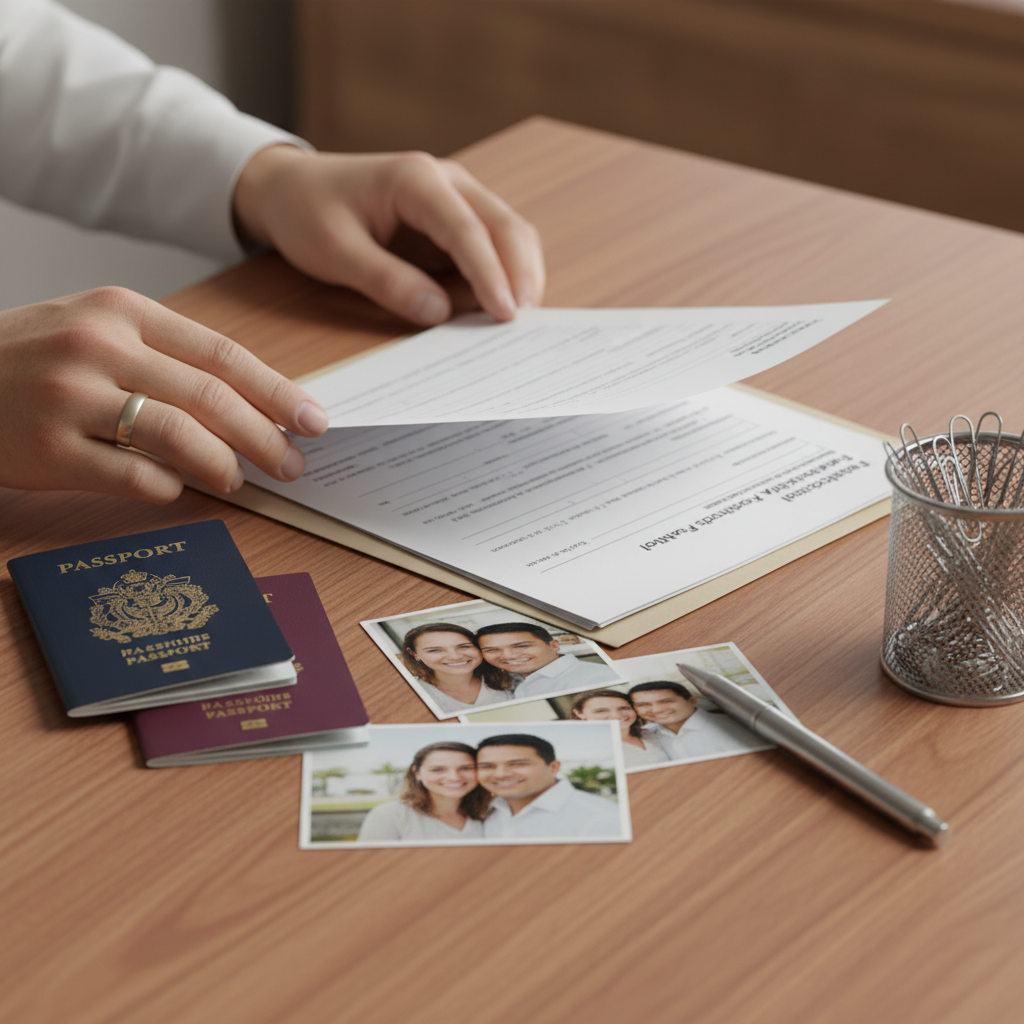
Types of Spousal Sponsorship: Inland vs. Outland
Inland sponsorship is for partners living together in Canada and supports an in-Canada open work permit. Outland sponsorship is filed when the partner lives abroad, often allowing travel flexibility. The best choice depends on residence, travel needs, interview risk, and work authorization goals.
Both paths lead to permanent residence. The inland route suits couples cohabiting in Canada who want work authorization during processing. The outland route is typical where the partner remains abroad or may need to travel freely for work or family commitments. Each carries different interview locations and processing dynamics.
| Factor | Inland | Outland |
|---|---|---|
| Where partner lives | In Canada | Outside Canada |
| Work during processing | Eligible for spousal open work permit | Not typical; depends on separate permits/visas |
| Travel flexibility | Leaving Canada can complicate matters | Generally more travel flexibility |
| Interview location | Within Canada | Visa office abroad |
| Best for | Couples cohabiting in Canada, seeking work authorization | Partner abroad or frequent travel obligations |
Unsure which fits? We map your travel plans, work prospects, and risk profile to pick the right route, then tailor evidence accordingly.
Eligibility and Requirements
Sponsors must be 18 or older, a Canadian citizen or permanent resident, and free from recent sponsorship bars. Relationships must be genuine, with evidence showing marriage, 12 months of cohabitation for common-law, or conjugal commitment despite barriers. Applicants must clear medical, police, and biometrics checks.
Eligibility checks protect program integrity while accommodating diverse relationships. The undertaking to financially support the partner lasts 3 years from permanent residence. There’s no typical minimum income threshold for spousal cases, but sponsors must not be in default of previous undertakings or serious debts to the government.
- Sponsor basics: 18+, citizen/PR, residing in Canada or planning to return (citizens abroad must show intent)
- Barriers to eligibility: current bankruptcy, criminal ineligibility, past sponsorship defaults
- Relationship standards: real, continuing partnership—not primarily for immigration
- Applicant checks: biometrics (valid ~10 years), medical (valid ~12 months), police clearances (6+ months stays)
We flag any complexities early—prior marriages, long-distance periods, cultural considerations—and build a narrative backed by documents, affidavits, and consistent timelines.
Best Practices for a Strong Application
Treat your application as a narrative with receipts: a clear relationship timeline, joint documentation, and consistent forms. Label evidence logically, address gaps upfront, and prepare for possible interviews. Strong organization reduces delays and follow-up requests.
In our experience, the best files don’t merely stack documents—they explain the relationship journey with corroboration. Aim for clarity over volume. If you lived apart, show why and how you stayed connected. If finances or housing changed, explain the context.
- Timeline first: key dates for meeting, visits, cohabitation, engagement, marriage, moves.
- Evidence groups: identity, relationship, joint life, communications, admissibility, affidavits.
- Label cleanly: use descriptive file names and a contents index.
- Anticipate gaps: add a brief letter of explanation for long-distance periods or name discrepancies.
- Prepare for interviews: practice consistent answers and details only you would know.
We often create a concise submission brief summarizing the story and pointing officers to exhibits—making the file faster to assess.
Tools, Portals, and Helpful Resources
Use the correct IRCC online portal, track biometrics and medical requests, and keep police certificates current. Supplement with affidavits when needed. For context, review reputable guides while relying on your lawyer’s tailored legal advice for strategy and risk.
Public guidance can help you plan, but it isn’t a substitute for case-specific legal advice. When you need orientation, well-organized third-party explainers provide context while you build your official forms and evidence.
For additional background, you can consult broad explainers like these:
Some readers find value in a spousal sponsorship checklist for organizing documents, or a concise overview of sponsorship requirements to frame eligibility, as well as a broader family sponsorship guide to understand categories. Use such summaries for orientation, then confirm details in your official instructions.
We handle the formal steps, ensure your evidence aligns with regulations, and step in quickly if officers request more information.
If Things Go Sideways: Appeals and Judicial Review
After a refusal, you may appeal to the Immigration Appeal Division (IAD) or seek judicial review at Federal Court. Appeals consider new evidence and humanitarian factors; judicial review tests the decision’s legality. Fast, strategic action preserves rights and improves outcomes.
Appeals and reviews differ. An IAD appeal focuses on whether the refusal was wrong in fact, in law, or both, and can weigh humanitarian and compassionate circumstances. Federal Court judicial review is not a do-over; it examines whether the decision was reasonable procedurally and substantively. Timelines are short—contact counsel promptly.
- IAD sponsorship appeals: develop a focused record, witness outlines, and persuasive submissions.
- Judicial review: file for leave, argue legal error or unreasonableness, and seek a re-determination.
- Mandamus strategy: in prolonged delay scenarios, explore targeted remedies after assessing risks.
Rathod Law Firm supports sponsorship appeals and Federal Court work, drawing on experience with immigration litigation and hearings to recalibrate your path.
Case Studies and Real-World Examples
Well-planned files succeed because they make it easy to say yes. When issues arise—distance, prior refusals, thin documents—careful narratives and corroboration often tip decisions. The following anonymized scenarios show how targeted strategy makes a difference.
Case 1: Long-distance, then cohabitation
A Brampton couple met abroad and maintained a two-year long-distance relationship before marrying and moving in together near Empire College Canada. We built a timeline with travel stamps, video call logs, and joint lease records. The officer issued no interview; approval followed standard checks.
Case 2: Sparse paperwork, rich testimony
Newlyweds without joint finances strengthened their file with affidavits from close family, dated photos spanning seasons, and consistent messages. We added a succinct explanation about cultural norms around separate accounts. The structured narrative reduced follow-up requests.
Case 3: Refusal overturned on appeal
An outland case was refused for perceived inconsistencies. On IAD appeal, we provided clarifying evidence, cross-referenced dates, and prepared thorough testimony. The panel allowed the appeal, directing a new assessment; the couple received permanent residence following reprocessing.

Practical Checklist and Typical Timelines
Plan your file in phases: eligibility and strategy, evidence build, forms and submission, biometrics and medicals, and decision. Inland applicants may add an open work permit step. Organized files tend to move with fewer interruptions and clearer status updates.
- Phase 1: eligibility screening, document plan, relationship timeline (1–2 weeks to assemble)
- Phase 2: collect proofs—housing, finances, communications, travel (varies by couple)
- Phase 3: complete forms, double-check dates/names, upload to correct portal
- Phase 4: watch for biometrics/medical instructions and requests for more information
- Phase 5: decision, confirmation steps, and landing logistics
Processing times fluctuate by volume and case complexity. Strong files answer obvious questions upfront, reducing back-and-forth that can add weeks or months.
How Rathod Law Firm Supports Your Application
We combine immigration planning with litigation readiness. From evidence mapping and portal submissions to IAD appeals and Federal Court strategy, our integrated lawyer–paralegal team keeps your sponsorship on track and defends it if challenged.
Here’s what working with our Brampton team looks like.
- Focused consultation: clarify eligibility, inland/outland choice, risks, and work permit options.
- Evidence blueprint: build a narrative with corroborating documents and affidavits; organize exhibits.
- Submission quality: precise forms, consistent dates, and responsive cover letter and index.
- Issue response: timely answers to officer requests; interview prep when needed.
- Appeal-readiness: if refused, immediate IAD and judicial review assessment to preserve rights.
Need notarization for declarations or translation affidavits? Our office handles affidavits and statutory declarations on-site, simplifying logistics for couples across Brampton and the GTA.
Considering spousal sponsorship? Schedule a focused immigration consultation with Rathod Law Firm to map eligibility, documents, and timelines—then execute with confidence.
Common Pitfalls to Avoid
Most refusals stem from thin evidence, inconsistent dates, or forms that don’t match the story. Solve this by cross-checking timelines, labeling exhibits clearly, addressing gaps directly, and preparing for an interview. Don’t assume officers will “fill in the blanks.”
- Disjointed evidence: photos without context or dates; add captions in your index.
- Missed history: ignoring prior visas/refusals; disclose and explain.
- Name/date mismatches: fix discrepancies with supporting records and brief explanations.
- Admissibility surprises: expired police certificates or outdated medicals; diarize expiries.
- Portal errors: wrong form set or missing signatures; confirm the correct platform and version.
When in doubt, get tailored legal advice before you submit. It’s much easier to prevent problems than to fix them on appeal.
Frequently Asked Questions
These quick answers address the most common questions about spousal sponsorship—eligibility, inland versus outland, proofs of genuineness, and options after a refusal. For case-specific advice, book a consultation so we can assess your facts and documents directly.
Who can be sponsored under spousal sponsorship?
A legally married spouse, a common-law partner after at least 12 months of continuous cohabitation, or a conjugal partner when genuine commitment exists but cohabitation or marriage faces barriers. All applicants must pass medical, police, and biometrics checks.
Should we apply inland or outland?
If you live together in Canada and want work authorization during processing, inland often fits. If your partner lives abroad or needs travel flexibility, outland may be better. The right choice depends on residence, travel needs, interview risk, and timing.
What proves a genuine relationship?
Use a timeline with joint housing and finances, wedding and family photos over time, communication logs, travel itineraries, and affidavits from loved ones. The goal is a coherent story backed by documents, not a random pile of papers.
What if our application is refused?
You can appeal to the Immigration Appeal Division or seek judicial review at Federal Court, depending on your case. Appeals consider new evidence and humanitarian factors; judicial review examines the decision’s reasonableness. Act quickly to preserve your options.
Conclusion and Next Steps
Winning spousal sponsorship cases center on eligibility, a genuine relationship story, and organized evidence. Choose the right processing stream, anticipate officer questions, and act quickly if refused. With the right plan, partners reunite in Canada and move forward securely.
Key takeaways
- Start with eligibility and the right inland/outland choice.
- Tell a clear, documented relationship story with corroboration.
- Track biometrics, medicals, and police certificate timelines.
- Prepare for interviews and answer requests precisely.
- Appeal or seek review promptly if refused.
Ready to move? Book a focused consultation with Rathod Law Firm in Brampton to plan your spousal sponsorship from first document to final decision.